
There is a particular sound a brand makes when it folds. It is not a scream. It is the soft, laminated hum of a legal-and-comms note being read aloud by someone who has never in their life used the word “sentiments” in a sentence they meant.
GIVA made that sound earlier this month. Its thirty-five-second Raksha Bandhan film, live since July 20, featured Kriti Sanon in an ivory blouse and draped skirt, tying a rakhi first to her brother and then to the family dog. The proposition was not exactly a challenge to the Upanishadic corpus: love is love, protection is protection, the dog counts. For a month nothing happened, because for a month nobody had decided to be angry yet.


Then somebody did, and the machine started, and by the end of it the brand had announced that it had the highest regard and deep respect for Indian culture, that hurting sentiments was never the intent, and that the advertisement had been withdrawn from all media ‘out of respect’. Two words doing the work of a full apology while carefully admitting nothing, which is the house style of Indian corporate surrender and has been since Tanishq’s Ekatvam went down in 2020.
The neckline and the dog
Two charges, and it is worth separating them, because both are instructive and neither survives contact with the tradition being defended.
The first is the neckline.
Kangana Ranaut, who is an actor and a sitting MP and therefore doubly qualified to adjudicate the wardrobe of other women, described the film as intentionally creepy and likened the styling to a bikini. Sanon’s reply was the best line anyone produced all week: culture and traditions are in her heart, not in her neckline. Her sister Nupur, who is the person actually receiving the rakhi in the family, asked the only question that matters: if she has no problem with it, why does anyone else? Rahul Gandhi eventually turned up to say that what a woman wears is her own business, at which point the argument stopped being about an advertisement and became about which political formation gets to own the concept of Indian womanhood, a fight that will outlive all of us.
The second charge is the dog, and this is where the self-appointed custodians of the faith should have quietly checked their sources before going to press.
A dog named Dharma
In the Mahaprasthanika Parva, the Pandavas walk north to die. They fall one by one until only Yudhishthira is left, accompanied by a dog that has followed him the entire way. Indra arrives with the celestial chariot and offers him swarga, and Yudhishthira, who has by this point lost his wife, his brothers, his kingdom and most of his illusions, refuses to board unless the dog comes too. He argues with the king of the gods about it. He wins. The dog then reveals itself to be Dharma.
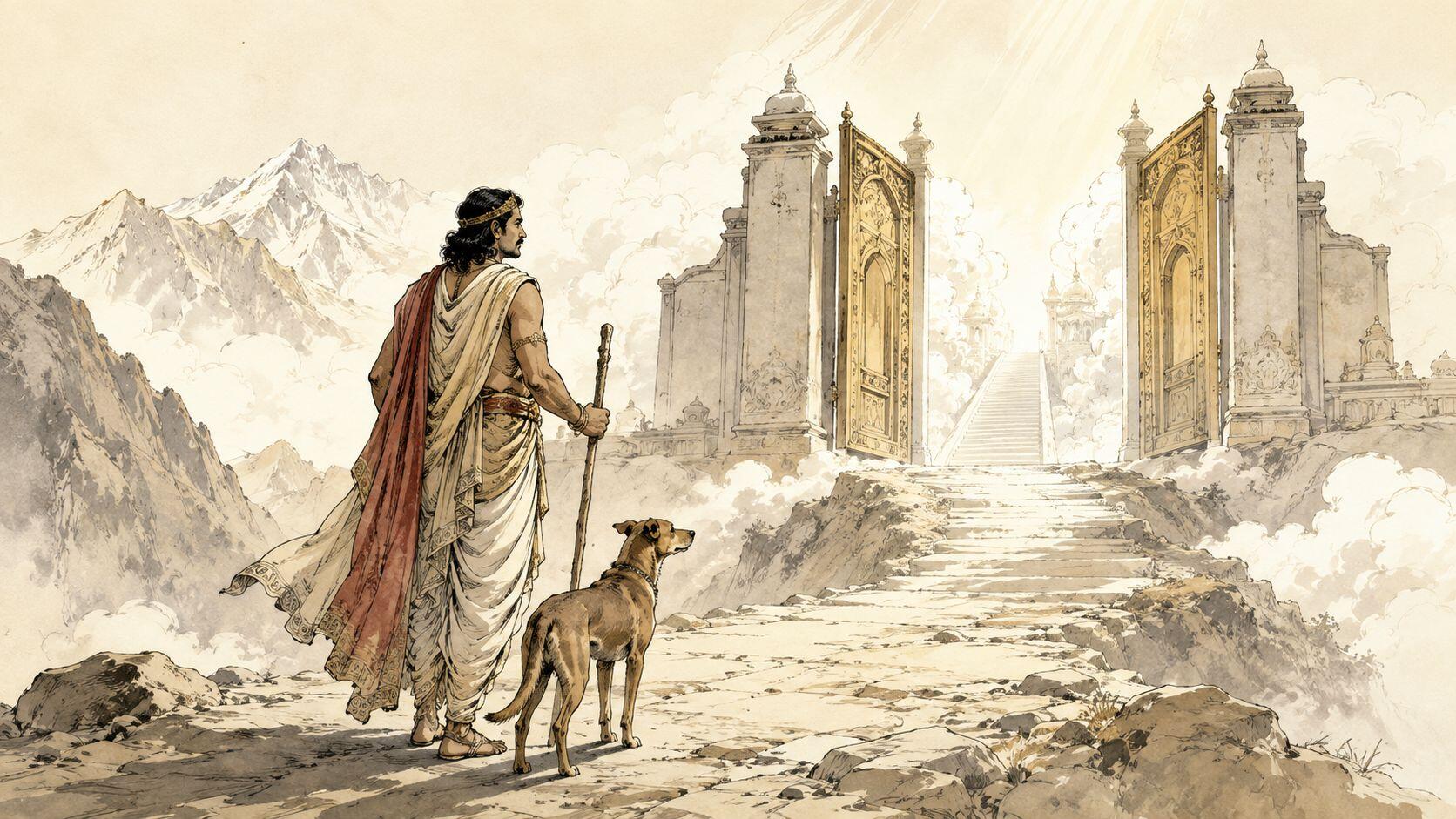

That is not a marginal gloss from some regional recension. That is the closing movement of the epic. The last moral test administered to the most righteous man in the tradition is whether he will abandon a dog, and he passes by refusing.
Kashi’s ‘kotwal’ Bhairava rides a dog. Across the border in Nepal, Kukur Tihar sets aside an entire day of the festival to garland dogs and mark their foreheads and feed them well, which is closer to what the GIVA ad was doing than anything its critics proposed as an alternative.
So the objection cannot be that Hindu tradition finds the dog beneath ritual notice. Hindu tradition put a dog at the gates of heaven and made the hero choose. The objection is something else, and it is worth naming plainly: the dog was a pretext. The neckline was a pretext. The actual grievance is that somebody exercised the authority to reinterpret a festival without applying for a licence first.
A faith without a head office
Nothing is. That is not a slogan; it is the structural fact.
There is no single book. There is no founder. There is no council, no synod, no consistory, no office that can issue a finding of heresy and have it stick. There are six orthodox darshanas that disagree with one another about the nature of reality, and one of them, Mimamsa, spends considerable energy arguing that the gods are not the point. There are bhakti poets who told the priesthood exactly where to put its ritual purity. There is a Charvaka tradition of thoroughgoing materialism that survives mostly in the furious rebuttals of everyone else, which is itself the proof that the argument was permitted.
Raksha Bandhan in particular has no scriptural costume code, because it has no scriptural anything. It is a folk practice that has been serially reinvented for centuries. Its most consequential reinvention happened here in Bengal in 1905, when Rabindranath Tagore, faced with a Partition designed to set Hindu against Muslim, told Calcutta to go out and tie rakhis on one another across the communal line. Men walked into neighbourhoods where they were not expected and tied thread on strangers. The festival’s greatest political hour was an act of deliberate, improvised, wildly unsanctioned expansion of who counts as kin.
A hundred and twenty-one years later, a jewellery brand suggests that the family dog also counts as kin, and we are told this is an assault on the tradition.
Even the gods were unsure
The tradition does not begin with a set of instructions. It begins with two questions, and neither of them is answered.
The Nasadiya Sukta is the 129th hymn of the tenth mandala of the Rigveda, seven verses in the trishtubh metre, composed in the northwest of the subcontinent well over three thousand years ago. It is the oldest sustained piece of cosmological reasoning in the Indian archive and quite possibly in any archive. In full, with a plain rendering:
नासदासीन्नो सदासीत्तदानीं नासीद्रजो नो व्योमा परो यत् ।
किमावरीवः कुह कस्य शर्मन्नम्भः किमासीद्गहनं गभीरम् ॥१॥
There was neither non-being then, nor being. There was no air, nor the sky beyond it. What stirred? Where? In whose keeping? Was there water, unfathomably deep?
न मृत्युरासीदमृतं न तर्हि न रात्र्या अह्न आसीत्प्रकेतः ।
आनीदवातं स्वधया तदेकं तस्माद्धान्यन्न परः किं चनास ॥२॥
There was neither death then nor deathlessness. There was no sign dividing night from day. That One breathed without breath, by its own impulse. Other than that, there was nothing at all.
तम आसीत्तमसा गूळ्हमग्रेऽप्रकेतं सलिलं सर्वमा इदम् ।
तुच्छ्येनाभ्वपिहितं यदासीत्तपसस्तन्महिनाजायतैकम् ॥३॥
Darkness there was, hidden by darkness at the outset. All this was water without distinction. That which was coming into being, wrapped in the void, was born as the One by the power of heat.
कामस्तदग्रे समवर्तताधि मनसो रेतः प्रथमं यदासीत् ।
सतो बन्धुमसति निरविन्दन्हृदि प्रतीष्या कवयो मनीषा ॥४॥
Desire came upon it in the beginning; that was the first seed of mind. Poets, searching their own hearts with wisdom, found the bond of being in non-being.
तिरश्चीनो विततो रश्मिरेषामधः स्विदासीदुपरि स्विदासीत् ।
रेतोधा आसन्महिमान आसन्त्स्वधा अवस्तात्प्रयतिः परस्तात् ॥५॥
Their cord was stretched across. Was there a below? Was there an above? There were placers of seed, there were powers: impulse beneath, and reaching forth above.
को अद्धा वेद क इह प्र वोचत्कुत आजाता कुत इयं विसृष्टिः ।
अर्वाग्देवा अस्य विसर्जनेनाथा को वेद यत आबभूव ॥६॥
Who truly knows? Who here can declare it? Whence was it born, whence this creation? The gods came afterwards, with the making of this world. Who then knows where it arose?
इयं विसृष्टिर्यत आबभूव यदि वा दधे यदि वा न ।
यो अस्याध्यक्षः परमे व्योमन्त्सो अङ्ग वेद यदि वा न वेद ॥७॥
Whence this creation arose, whether it formed itself or whether it did not, he who surveys it from the highest heaven, he surely knows. Or perhaps he does not know.
Read verse six twice. The gods came afterwards. They arrived once the universe had already been made, which disqualifies them as witnesses; the hymn rules out its own deities as sources. Then comes verse seven, which has the finest closing line in world religious literature and possibly the funniest. Having spent six verses building towards the one authority who might settle the matter, the poet reaches him, considers him, and concludes that he knows, or possibly does not.
Eight hymns earlier, the Hiranyagarbha Sukta takes the opposite approach and arrives in the same place. Rigveda 10.121 has ten verses, and nine of them close on an identical line:
कस्मै देवाय हविषा विधेम
kasmai devāya haviṣā vidhema. To which god shall we offer our oblation?
It opens with as confident an image of origin as the Vedas produce:
हिरण्यगर्भः समवर्तताग्रे भूतस्य जातः पतिरेक आसीत् ।
स दाधार पृथिवीं द्यामुतेमां कस्मै देवाय हविषा विधेम ॥१॥
In the beginning the golden womb arose. Being born, it was the one lord of all that exists. It held this earth and this sky in place. To which god shall we offer our oblation?
And so it proceeds for nine verses, each cataloguing what this power did, holding the earth, measuring out the sky, giving breath and giving strength, commanding even the gods, and each landing on the same shrug. The hymn knows precisely what was done. It has no idea by whom.
Then the tenth verse abandons the refrain and supplies a name:
प्रजापते न त्वदेतान्यन्यो विश्वा जातानि परि ता बभूव ।
यत्कामास्ते जुहुमस्तन्नो अस्तु वयं स्याम पतयो रयीणाम् ॥१०॥
Prajapati, no one but you has encompassed all these born things. Let what we desire in offering to you be ours. May we be lords of riches.
This is the inheritance. Not a code. It contains two of the oldest surviving pieces of Indian thought: one concludes that the overseer of the universe may not know how it began; the other spends nine verses failing to establish who is being addressed. Three thousand years later, the men who claim to speak for all of it cannot get through a thirty-five-second jewellery commercial without filing a complaint.
Why GIVA folded
There is a case to be made for GIVA, and it deserves to be made properly rather than sneered at. When Tanishq pulled Ekatvam, it cited concern for the safety of its people, and that was not a euphemism. Online anger in this country reliably relocates itself to physical addresses, and the physical address of a jewellery brand is a shop with a shutter and a twenty-four-year-old on the counter earning less in a month than the ad cost per second. A founder who withdraws a campaign to keep that person from being shouted at, or worse, is not a coward. He is doing arithmetic.
But that is precisely the indictment, not the exoneration. The withdrawal was rational, which means the intimidation worked, which means it will be attempted again next festival and the one after, because it costs nothing and it always succeeds. Every capitulation is a subsidy paid to the next mob. The veto now sits with whoever is angriest by Tuesday.
There is a final absurdity worth recording. Sanon is not merely GIVA’s ambassador; she is a strategic investor in the company. She therefore part-owns the brand that deleted her. She supplied the conviction and the equity, and the enterprise supplied the delete button.
Bread, circuses and a jewellery ad
Juvenal had the mechanism worked out by the end of the first century in Rome. His complaint in the tenth satire is not really about the mob’s appetites, which is how the line is usually deployed. It is about an abdication. A people that once conferred imperium, that handed out the legions and the commands, had by his day withdrawn from all of it and anxiously wanted only two things: ‘panem et circenses’.
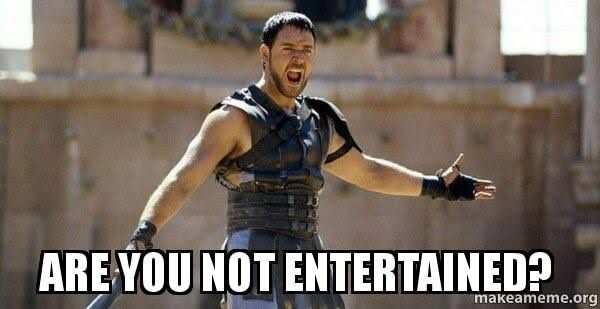

Switch on a television channel in this country at nine in the evening and you will find him vindicated nightly. We seem to have an infinite capacity in this democracy for loquacious nonsense that has no bearing whatever on our everyday lives. Thirty-five seconds of festival footage for a jewellery brand occupied a week of national attention, pulled in a sitting Member of Parliament and the Leader of the Opposition, and generated more discussion than most things that will actually determine how anyone lives this year. It was an ideal circus. It costs nothing to stage; it is infinitely renewable; it involves a famous woman and a dog; and at the end of it nobody’s water supply has improved and nobody’s wages have moved.
There is an obvious objection to all this, which is that I have just spent two thousand words on the circus myself. Taken. But hold the distinction between the trivial and the consequential, because this particular circus is trivial in its subject and consequential in its precedent. Nothing whatsoever turns on whether GIVA ran that film. A great deal turns on whether a brand, a publisher, a university or a newspaper in this country still believes it can hold a position for seven consecutive days. That is the muscle being tested. It is being tested on soft targets, on advertisements and syllabi and eight-hundred-page books about the Rigveda, precisely because soft targets are how you train.
The people who forced this down will tell you they were protecting a five-thousand-year-old civilisation. A civilisation that has absorbed Buddhism, Islam, Christianity, colonialism, twelve major language families and the entire concept of the multiplex does not need protecting from a woman in a cape and a dog with a thread on its leg.
It survived Yudhishthira arguing with Indra at the gates of heaven. It will survive Raksha Bandhan.
Eight books you ought to read to argue with me better:
- Why I Am a Hindu by Shashi Tharoor
- Three Hundred Ramayanas: Five Examples and Three Thoughts on Translation by A. K. Ramanujan
- The Hindus: An Alternative History by Wendy Doniger
- The Argumentative Indian by Amartya Sen
- Rama Retold by C. Aubrey Menen
- Shivaji: Hindu King in Islamic India by James Laine
- Such a Long Journey by Rohinton Mistry
- One Part Woman by Perumal Murugan
Disclaimer
Views expressed above are the author’s own.


.jpg "‘ಎನ್ವಿಡಿಯಾ’ ಟ್ರೈಲರ್ಗಳನ್ನು ಕಳ್ಳರು ಕದಿಯುತ್ತಾರೆ. ಅವರು 20 ಟನ್ ಮರಳನ್ನು ತೆಗೆದುಕೊಂಡರು")








Leave a Reply