
Last year, I went to Dublin and took the Jameson Distillery tour. After a few product samples, my friend (who has clearly read one too many investing books) asked the guide, “How much does a bottle of Jameson appreciate over time?” I watched the man short-circuit in real time before giving a long-winded, politician-esque speech that never really answered anything. That question clearly wasn’t on the training script.
Every time I run into a chatbot that can’t give me a direct answer, I think of that tour guide. Basic bots are decision trees with a friendly, AI-generated avatar, and the moment you go off script or ask something unusual, you’re waiting on a human representative.
Conversely, modern conversational AI platforms can handle messy, unscripted phrasing, maintain context over a long exchange, pull an answer from your help center, and—most importantly—go do something about it.
To help you give your customers the answers they deserve (even the obscure financial ones), I went looking for the best conversational AI platforms on the market. I tested every product I could, dove into an embarrassing amount of research when I couldn’t, and now present to you my findings as a conversational AI tour guide.
The best conversational AI platforms
What is a conversational AI platform?
A conversational AI platform is the software you use to build, deploy, and manage text- or voice-based AI agents that talk to your customers. These conversations can happen via web chat, SMS, WhatsApp, in-app messaging, or a phone line. Soon enough, probably telepathy too.
An important distinction: I’m not talking about AI chatbots like ChatGPT, Claude, or Gemini (even if conversational AI platforms often run on the same AI models as those chatbots). Those are general-purpose assistants that you talk to. Everything on this list is for building an agent that your customers talk to. That’s a pretty different job. It only knows your business, it’s trained on your documentation, you decide which systems it’s allowed to touch, and the only thing it gets judged on is whether it resolved the ticket.
What makes the best conversational AI tool?
How we evaluate and test apps
Our best apps roundups are written by humans who’ve spent much of their careers using, testing, and writing about software. Unless explicitly stated, we spend dozens of hours researching and testing apps, using each app as it’s intended to be used and evaluating it against the criteria we set for the category. We’re never paid for placement in our articles from any app or for links to any site—we value the trust readers put in us to offer authentic evaluations of the categories and apps we review. For more details on our process, read the full rundown of how we select apps to feature on the Zapier blog.
The best conversational AI tool is the one that holds up in your hardest customer conversation. Any chatbot can answer “where’s my order?”—the good ones stay on the rails when things go sideways. Customers have unique requests, and you need an agent (and a conversational AI platform behind it) that can handle those without short-circuiting or punting to a human every time.
Besides that, I also weighed every product against a few key criteria:
-
Custom agent building: How easily can you build, train, and control an agent using your own documentation, rules, and brand guidelines? I looked for visual builders, knowledge base ingestion, and guardrails strict enough to keep the agent from improvising.
-
Conversation quality: The agent has to understand how normal people talk and phrase things, hold context across a long back-and-forth, and answer accurately instead of confidently making something up. Model choice, multi-turn memory, and a sane fallback when confidence is low all factored in here.
-
Channel coverage: You should be able to build your conversation logic once and deploy it everywhere your customers are, whether that’s a web chat widget, your mobile app, WhatsApp, SMS, Slack, or a phone line. Not all of the products on my list can exist everywhere, but I gave it extra brownie points if it did.
-
Integration depth: An agent that can only talk is a very expensive FAQ page. I prioritized platforms with native webhooks, CRM and database triggers, Zapier integration, and live-agent handoffs that pass the full transcript so customers don’t have to repeat themselves.
The best conversational AI platforms at a glance
|
Best for |
Standout feature |
Pricing |
|
|---|---|---|---|
|
Fin |
Speed to deployment |
Deployment without configuring your tech stack |
Plans start at $0.99 per outcome with a 50-outcome monthly minimum |
|
Voiceflow |
Owning your agent end-to-end |
Can choose an LLM or use your own |
Contact for business pricing |
|
Google Conversational Agents |
Teams already on Google Cloud |
Different building models for specific outcomes and use cases |
Pay-as-you-go |
|
Decagon |
Improving agents after launch |
Duet analyzes agent conversations and refines output |
Contact for pricing |
|
Kore.ai |
Regulated industries |
ABL, a custom programming language |
Contact for pricing |
|
NiCE Cognigy |
High-volume contact centers |
Voice Gateway connects straight to call center software |
Contact for pricing |
Best conversational AI platform for speed to deployment
Fin (Web)

Fin pros:
-
Can run on your existing helpdesk, inheriting your assignment rules, escalation paths, and reporting
-
Outcome-based pricing with no setup, integration, or platform fees
-
Simulations and regression tests
Fin cons:
-
The analytics layer is part of the Pro add-on at $99/month, on top of outcome charges
-
Fin runs on its own proprietary model suite, so there’s no swapping in a different LLM if you have a model preference
If you’ve watched TV at some point since the late ’90s, you know all about love triangles. Let me propose a new, confusing one to you: customer service software Intercom created an AI agent called Fin, liked the name enough to rename the entire company Fin in May 2026 (the helpdesk software is still called Intercom), and then a month later agreed to sell itself to Salesforce for about $3.6 billion. You don’t really need to know all of that to use Fin, but I spent too much time untangling the product overlap not to force you to understand it too.
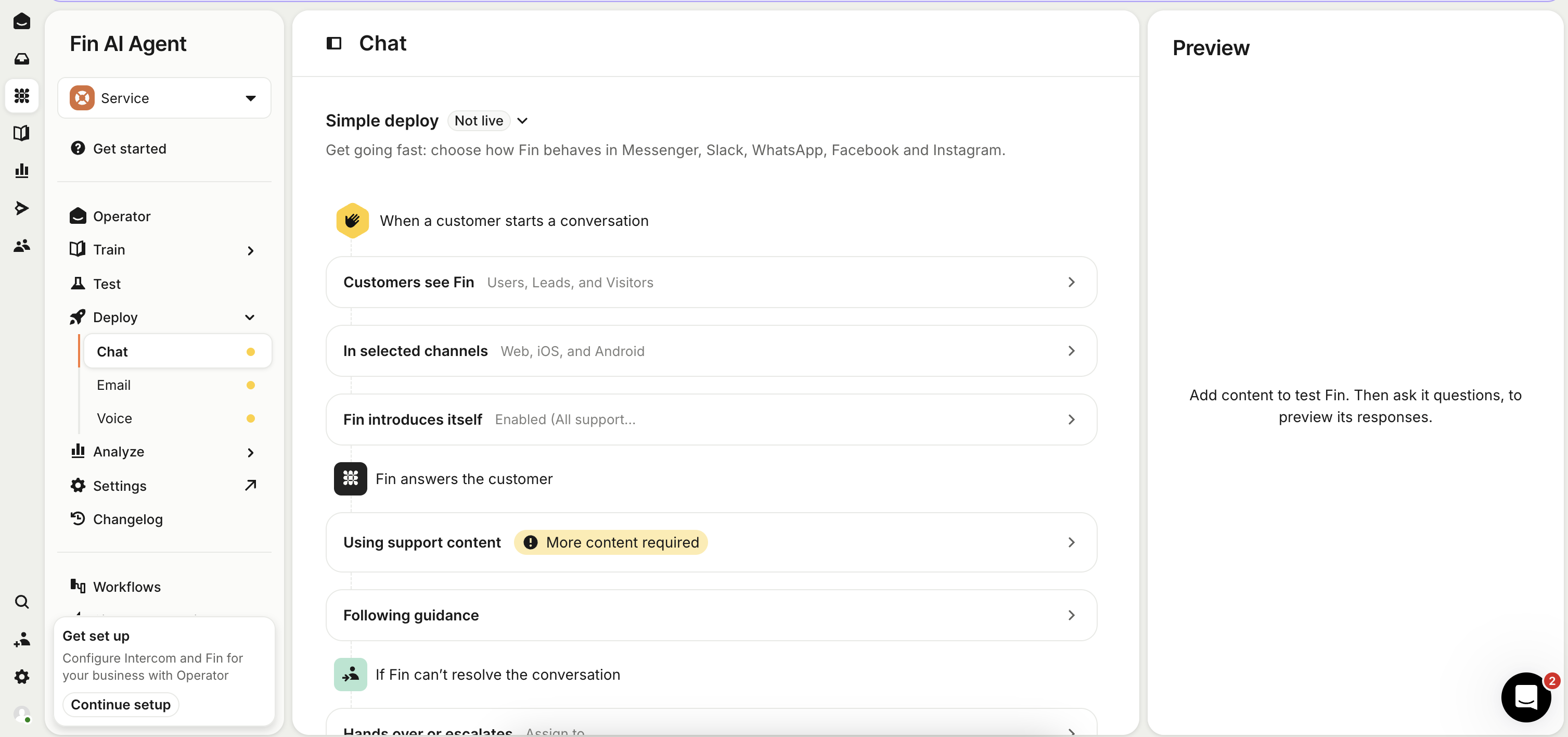
Fin is one of the only tools here that you can deploy without touching your existing support stack. It advertises setup in under an hour, and that’s believable because it doesn’t ask you to migrate anything. You just need to connect it to your existing helpdesk, and Fin picks up the assignment rules, automations, and reporting you already configured, then escalates into the inbox your agents already have open.
Training Fin is pretty straightforward. You can introduce the tool to your knowledge sources and data connectors, establish procedures for multi-step tasks (like refunds or order changes), and give it rules for tone and policy. Before you take it live, you can run simulations and regression tests to watch how it behaves in a sandbox environment, rather than finding out it’s sobbing to your customers about its newest love triangle. Once it’s all set, deploy it across live chat, email, WhatsApp, SMS, Slack, Instagram, Facebook Messenger, and voice.
One of the clearest drawbacks here, however, is that you’re configuring Fin, not building your own agent. This product runs on Fin’s own models, with no option to bring your own. If you need a specific model for your AI policy or if you want to architect conversation logic yourself, you won’t find it here. But if you’re a support team that just wants a competent agent resolving tickets by the end of the month, this is one of the best products to do that. You’ll just be doing it Fin’s way.
Fin pricing: Plans start at $0.99 per outcome with a 50-outcome monthly minimum. The Pro add-on, which includes Operator and the AI analytics suite, starts at $99/month; Copilot is $35 per user/month.
Best conversational AI platform for owning your agent end-to-end
Voiceflow (Web)

Voiceflow pros:
-
Pick any major model or bring your own
-
Separate dev, staging, and production environments
-
Free trial with no credit card
Voiceflow cons:
-
Business pricing isn’t published, so budgeting still starts with a demo
-
You’re designing the agent yourself, which can delay launch timelines
Voiceflow emerged from humble beginnings. It started as a design tool for Alexa skills and has since blossomed into a full agent-building platform for CX teams. With it, you can design an agent on a canvas, decide what it can do and how it behaves, and keep the keys and permissions to all of it—including which model it runs on.
That last part deserves a “last but certainly not least” label. Voiceflow lets you choose among the major LLM providers or bring your own model, and work with them where they make most sense for your business. Anthropic and OpenAI seem like they ship a better model every week, so being able to swap yours without rebuilding the agent could save your teams a few bottles of Advil.
The canvas balances agentic playbooks with deterministic workflows, all governed by global instructions and guardrails. This means your agents follow a script where you want them to, and bust out a little jazz improvisation when you allow it. A knowledge base integration can ground agent answers to your documentation (like many other tools here), developer APIs and custom code give you a little extra oomph beyond the visual builder, and separate dev, staging, and production environments let you push changes through a pipeline.
That said, building your own agent means a timeline, a task force, and likely a few deadline extensions that you didn’t plan for. If that suits you, Voiceflow’s Zapier integration extends the agent across your stack—start an agent conversation or kick off an outbound call based on activity from any of 9,000+ apps.
Voiceflow pricing: Contact for business pricing.
Best conversational AI platform for teams already on Google Cloud
Google Conversational Agents (Web)
Google Conversational Agents pros:
-
Published per-turn rates: $0.007 a chat turn on Flows, $0.012 on generative Playbooks
-
It runs in your existing Google Cloud project on the same IAM, logging, and billing
-
$1,600 in trial credits ($600 for deterministic flows and $1,000 for generative features) between the two agent types
Google Conversational Agents cons:
-
If a Playbook calls a Flow, every turn in that conversation bills at the higher generative rate
-
Voice bills the full generated audio even when the customer talks over it
Here we have another product with a complicated past. Once upon a time, this tool was called Dialogflow. Google picked it up back in 2016 and, at the end of 2025, folded it into Vertex AI Agent Builder to create a single Conversational Agents console. From your perspective, that’s either a tidy consolidation or the third or fourth rename you’ve lived through if you’ve been paying attention long enough.
Either way, it’s the option that makes the most sense when your infrastructure already lives on Google Cloud—agents run in your existing project, under the IAM roles you’ve already assigned, billed to the same account your finance team already approved. The pricing is pretty favorable and surprisingly transparent, too (chat turns run $0.007 on deterministic Flows and $0.012 on generative Playbooks), so the whole package is a pretty easy sell to your higher-ups.
Now for some of the more under-the-hood specifics. You build with Flows for the paths that need to have exact outcomes (like a verification check), Playbooks for the ones that need to reason (like a unique customer problem), and Data Stores to help your agent surface answers from your internal docs. Playbooks run on Gemini, with temperature and token limits adjustable per playbook. Versions and environments are where you modify the release pipeline, webhooks connect to your other apps, and everything lands in Cloud Logging so you can go back and see what happened.
While the billing is attractive on paper, it has a small catch. For example, a Flow calling a Playbook only charges generative rates for the generative turns, but a Playbook calling a Flow charges the entire conversation at the higher rate. This can be a costly mistake if you conflate the two. Voice also bills the full generated response even when a customer interrupts it. And because you’re building on cloud primitives rather than buying a CX product, there’s no contact center, no agent desktop, and no one to run to for problems unless you designate someone on your team for that.
If you’re not already on Google Cloud, most of the “advantages” probably don’t make sense for your use case. If you are, nothing else here is going to be this cheap or this easy to get approved.
Google Conversational Agents pricing: Pay-as-you-go. Chat: $0.007 per turn (Flows), $0.012 per turn (Playbooks). Voice: $0.001 per second (Flows), $0.002 per second (Playbooks).
Best conversational AI platform for improving agents after launch
Decagon (Web)
Decagon pros:
-
Agent logic is in plain English
-
Simulated conversations and A/B tests can monitor agent changes
-
Every decision is traceable down to which help article it used
Decagon cons:
Launching a conversational AI agent is the easy part (relatively speaking). The hard part is three months down the road, when your agents start going off the rails and telling your customers about the new episode of Love Island instead of processing their refund. Decagon helps you keep these conversations under control, so you can tweak an agent’s output rather than binning it and starting from scratch.
Duet is the feature that does most of that work. It reads your real conversations, identifies situations where your agent performed less than stellar, and then generates, tests, and refines the output. So, instead of painstakingly reviewing transcripts on a Friday afternoon and filing tickets, you review changes Duet has already proposed, drafted, and validated.
The rest of the platform is about as approachable. Agent logic is written in plain English (inside the Agent Operating Procedures), so any approved user can write new agent procedures. You can run changes in a sandbox before launch. Experiments let you version an agent, and the A/B testing gives you real numbers off live traffic instead of a hunch.
The one main drawback I found is that channel coverage is pretty light compared to other tools on this list. It offers chat, voice, and email, but no sign of social or messaging. Decagon also makes the most sense when you already have an agent live and it isn’t doing a great job. If you’re still trying to get one out the door, start somewhere else on this list.
Decagon pricing: Contact for pricing.
Best conversational AI platform for regulated industries
Kore.ai (Web)
Kore.ai pros:
-
Agent logic gets validated before launch
-
Every session is audited rather than 5–10% sampled
-
Arch turns a plain-English description into a real agent definition
Kore.ai cons:
-
Automation AI bills in 15-minute sessions, including idle time (so a 31-minute chat counts as three sessions)
-
Your team probably has to learn ABL
Kore.ai is a decade-plus-year-old enterprise AI company, and it’s spent most of that time doing conversational AI for large, regulated organizations. Go to the homepage, and you’ll feel like you’re in an Office Space-style waiting room, with nods to Morgan Stanley, Citi, Vanguard, and odd suburban office building architecture. In 2026, it relaunched its platform as {Artemis}—yes, the brackets are a package deal—repositioning from a general chatbot builder to an enterprise agent platform.
This product asks a little more of you than anything else on my list, and that’s due to ABL (Agent Blueprint Language), Kore.ai’s programming language of sorts. Instead of assembling an agent out of prompts, crossed fingers, and a dream, you can define its behavior, tools, guardrails, orchestration, and handoff rules in a typed language that compiles. Policies are enforced by the engine rather than by the model, so the agent can reason as much as it likes and still can’t step outside the data or conversational boundaries you set from the start.
Kore.ai knows that writing a formal language for every single agent you build would be worse than an 8:30 a.m. commute. So it graciously gives you Arch, an AI solution architect that turns plain-language intent into ABL you can review and refine. You build in Agent Studio using visual or code-based authoring, or work through Claude Code, Cursor, or Codex if your engineers would rather stay in their editor, then deploy across voice, web, Slack, Teams, and mobile.
The problem with this product is that the wrong teams will bite off more than they can chew. The billing structure is obscure, ABL is a language your team actually has to learn, and the initial ramp-up time seems daunting. If you’re a business that’s better suited for a plug-and-play option (like Fin), this will feel like being handed a flight manual and the keys to a single-seat airplane when all you need is an Uber. But if you’re in banking, insurance, or healthcare and every agent decision needs a paper trail, Kore.ai could be exactly what you need.
Kore.ai pricing: Contact for pricing.
Best conversational AI platform for high-volume contact centers
NiCE Cognigy (Web)
NiCE Cognigy pros:
-
Plugs into the phone system you already run, so you’re not replacing your contact center to add AI
-
Supports 25,000+ concurrent interactions across 100+ languages
-
You can assign a different LLM to each job
NiCE Cognigy cons:
NiCE Cognigy is the product for teams who have a customer support phone number, a queue, and a very bad Monday when something goes wrong. Take a stroll down its customer list, and you’ll find airlines, automakers, and logistics companies. This should tell you right off the bat that it specializes in situations with enormous volume, multiple languages, and customer demand that can spike at a moment’s notice.
While the platform has a few use cases, Voice Gateway is why it’s on my list. It plugs straight into Genesys, Avaya, Amazon Connect, NiCE CXone, and 8×8, so an AI agent can pick up the line your customer already knows, and route the call into a queue you already staff and monitor. The platform supports 25,000+ concurrent interactions and 100+ languages—Lufthansa, for example, uses it through peak days of up to 375,000 interactions, on the way to roughly 16 million conversations a year.
You can build agents by defining a persona and assigning Jobs (like billing questions, or flight rebooking), each with its own marching orders about how to call APIs, pull records, or hand off interactions to a human. Knowledge AI allows agents to source answers from your internal documentation, while Composite AI lets you combine rigid intent-based flows with agentic reasoning in one conversation. So, for example, an agent could start an interaction with a standard identity verification followed by a flexible dialogue. You can also point to different jobs at different LLMs from OpenAI, Anthropic, Google, or AWS.
Overall, NiCE Cognigy is a lot of pomp and circumstance if you’re a 12-person team fielding tickets in a shared inbox. But for a contact center drowning in call volume, this tool can toss you a flotation device.
NiCE Cognigy pricing: Contact for pricing.
Conversational AI tool honorable mentions
The conversational AI world is crowded, and six tools aren’t enough to give you the full scope. While I stand by my list, I thought I’d give you a few more options to mull over if none of my picks work for you:
-
Sierra: This is a name you’ll likely see in other roundups. It charges per resolved conversation rather than per seat, which is appealing to the right team.
-
Ada: Ada is a long-running staple of B2C support automation, built for marketing and support teams to configure flows without engineering.
-
Microsoft Copilot Studio: This is the path of least resistance if your company already lives in Teams, Power Platform, and M365.
-
Zendesk AI: This one’s the obvious move for high-volume Zendesk shops, since it’s built into the suite you’re already paying for. It’s an add-on to a help desk rather than a standalone platform.
-
Yellow.ai: Yellow.ai gives you broad multilingual and voice coverage with a particularly large footprint across APAC, plus a free tier if you want to poke at it before committing.
-
Vapi and Retell AI: These two are developer-first voice infrastructure rather than finished platforms. Pick these if you have engineers who want raw voice orchestration and no interest in an admin UI.
Link your conversational AI platform to your tech stack with Zapier
There’s really not a “best” conversational AI platform—it all depends on your use case. Pick Fin if you want an agent answering tickets on your existing help desk this month; Kore.ai if an auditor is lurking around every corner; NiCE Cognigy if support means a phone queue and a (potentially) very bad Monday. I won’t rehash the entire list, but my point is you have options.
Whichever one you land on, though, it won’t be the only system that touches the customer. The agent resolves the conversation, and then something still has to update the rest of your processes.
That’s where Zapier comes in. With it, you can connect your conversational AI platform to 9,000+ apps across your tech stack and build end-to-end processes around customer communication. You could sync resolved tickets to your CRM, alert the right team when sentiment drops, or push transcripts into your data warehouse without anyone copying and pasting. And with Zapier MCP, you can do this all straight from your chat window.
Related reading:










Leave a Reply